Trending


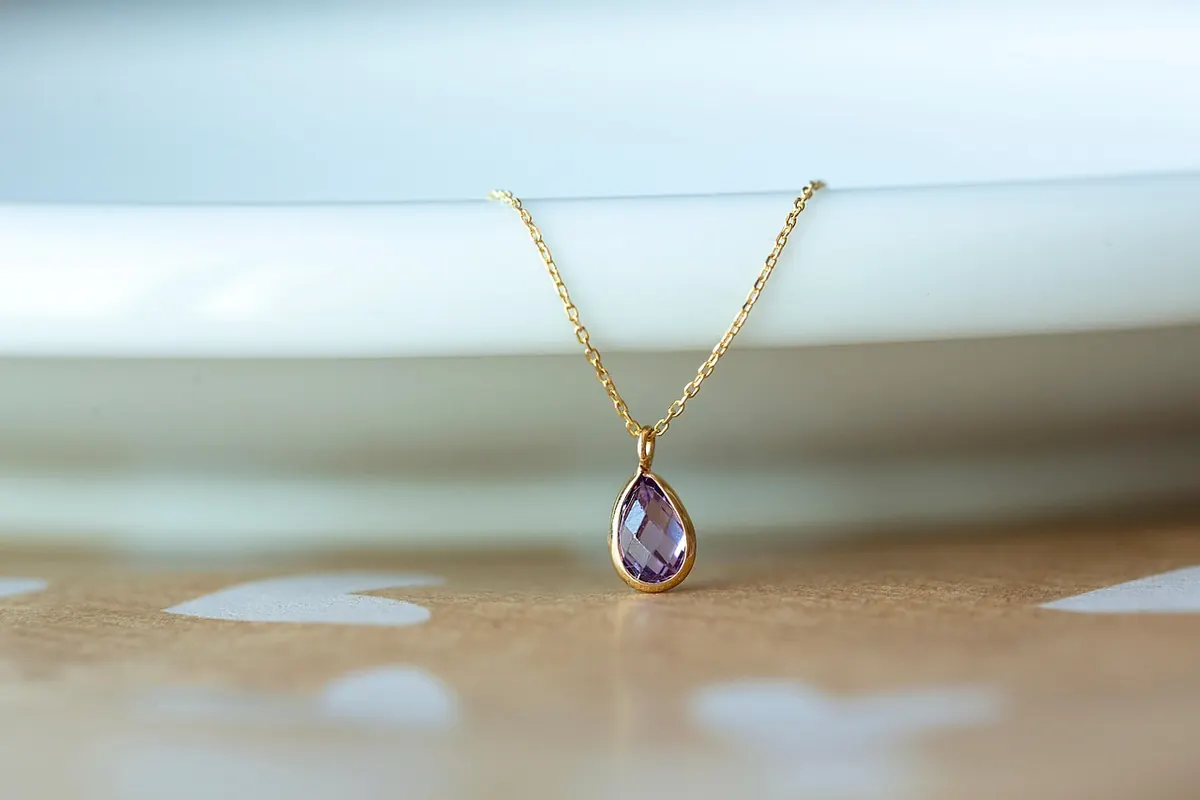
Choosing a topaz necklace usually starts with colour and cut: sky blue, deeper London blue, the warm apricot of imperial topaz, a briolette drop or a clean emerald cut. Length matters just as much, and it is the detail most people skip. The same pendant that looks elegant on an 18 in chain can look stranded on a 24 in one. Necklace lengths follow a rough standard, and once you know where each one sits, matching a chain to a neckline or a favourite topaz pendant becomes quick and deliberate.
A necklace is a frame. Where it falls decides what the eye notices first: the jaw and collarbone for a short chain, the bust for a matinee, the waist for an opera strand. Two topaz pendants of identical size can look completely different depending on that placement.
The most common mistake is a pendant that lands halfway between the neckline and the collarbone, so it looks as though it drifted there by accident. Aim for the pendant to sit either clearly inside the neckline opening — resting in the V of a wrap dress or scoop neck — or clearly below it.
Weight matters too. A large stone on a long, fine chain pulls forward and can twist off-centre. If you notice that happening, the fix is a slightly heavier chain or a shorter length, not a bigger clasp.
These are the sizes most jewellers work to. Body shape shifts the exact landing point, so treat them as ranges rather than rules.
There is a quiet gap between matinee and opera, roughly 25–27 in, where pendants tend to land awkwardly on the curve of the bust. If a chain sits there and looks unsettled, it usually needs to go noticeably shorter or longer rather than be adjusted by a centimetre or two.
Chokers suit open necklines best. With a crew-neck T-shirt a choker can crowd the collar, and a princess length with a small blue topaz pendant is friendlier. For a button-down shirt, undo the top two buttons and let a 45 cm chain settle into the opening. Keep the pendant modest here — a small oval, round or slender pear. A large statement pendant on a choker sits high and heavy, and the neckline starts to compete with it.
This is the length that flatters a deep V-neck or a wrap dress, because the pendant drops into the space the fabric has created. It also works over a fine knit, where a shorter chain would vanish into the wool. Briolette drops, cushion cuts and emerald-cut pendants all suit matinee lengths, since the extra chain gives a bigger stone room to breathe. Imperial topaz and London blue both read well here against a dark top.
An opera-length topaz strand is an evening tool. Worn long over a plain column dress it draws the eye downward and lengthens the silhouette. Doubled, it becomes a two-strand necklace sitting around princess length. Knotted near the collarbone, it gives you a choker with a long tail. With a high neckline or a turtleneck, double it and let the clasp hang at the front as a feature.
A quick test in the mirror: turn your head to the side, then look down. If the pendant slides off-centre or pokes at your collarbone, the length is wrong for that neckline, not the necklace.
Chain length is only half the story. The pendant's own drop adds to it. An 18 in chain with a 3 cm teardrop hangs at nearly the same level as a 20 in chain with a flat-set stone. When measuring, hold the pendant against the chain and measure to the bottom of the stone, not the top.
Match the chain to the weight of the piece: a fine box or cable chain for a small topaz, a curb, rope or bead chain for a larger cushion or cluster. Very fine chains on heavy pendants stretch and kink over time.
Topaz is 8 on the Mohs hardness scale, which is durable enough for regular wear, but it has perfect cleavage — a sharp knock at the wrong angle can chip the stone. Many blue and mystic topaz stones are treated or coated, so ultrasonic and steam cleaners are best avoided. Warm water, a soft brush and a soft cloth are gentler. Take a long, heavy pendant off before sport or DIY. If your stone is valuable, or you are unsure how it was treated, ask a qualified jeweller before cleaning it.
Layering works best with at least 5 cm (2 in) between chains, so they read as separate lines rather than tangling. A straightforward three-chain stack: a 40 cm choker with a tiny topaz, a 45–48 cm princess with a slightly larger pendant, and a 71 cm opera strand worn plain. Keep the heaviest chain longest and the lightest nearest the throat. If two chains cross constantly, the answer is usually a bigger difference in length or a lighter pendant, not a different clasp.
Measure once, properly, and you will rarely get it wrong again.
If the measurement falls between two standard lengths, buy the shorter chain and add an extender rather than committing to a length that only works with one outfit. A 5–8 cm extender gives you two lengths from one necklace and is an easy adjustment to arrange. A short neck usually
Photo: 3844328 / Pixabay